
Sleep debt and how to actually pay it back
Sleep debt is the running total of the gap between the sleep you need and the sleep you get. Recent debt is partly repayable. One twelve-hour Saturday is not how you repay it — several ordinary nights with an extra hour in them is.
What is sleep debt, and how far back does it go
Take your personal sleep need — for most adults that sits somewhere between seven and nine hours — and subtract what you actually slept. Do that nightly and keep a running sum. Six and a half hours against an eight-hour need is 90 minutes of debt. Five weeknights of that and you've lost most of a full night by Friday.
The accounting window that matters is roughly the last two weeks — not because the body keeps a 14-day ledger and wipes it on day 15, but because the deficits that still respond to extra sleep are the recent ones. Debt from March isn't sitting in an account waiting for a payment. So what is sleep debt in practical terms: a rolling balance from the last dozen or so nights, which is the span you can still do something about.
People underestimate their own balance because the subjective signal goes quiet. Under weeks of mild restriction, how sleepy you feel tends to plateau after the first few days while objective performance — reaction time, error rates, attention lapses — keeps sliding. You adapt to feeling tired. You don't adapt to being impaired.
How to calculate your sleep debt
Four steps, fourteen nights:
- Estimate your need. Not what you get by on — what you settle into on a stretch of days with no alarm and no catching up to do. Most people land in the seven-to-nine band, though genuine short and long sleepers exist. If you're unsure, the ranges by age are a starting point: how much sleep you actually need.
- Log time in bed for two weeks — bedtime to final wake, honestly.
- Subtract about 30 minutes a night for falling asleep and brief wake-ups you don't remember; healthy adults sleep roughly 85–90% of their time in bed. A tracker's estimate works too. Precision to the minute isn't the point.
- Add up the nightly shortfalls.
An eight-hour need against an average of 6h50 is 70 minutes a night, which is 16 hours and 20 minutes over two weeks — close to two full nights of sleep, missing. Most people's number comes out bigger than they'd guess.
Stop the bleeding before you plan the repayment
A balance that's still growing can't be paid down. The first move isn't a recovery weekend, it's holding the weeknight bedtime steady long enough that the debt stops compounding.
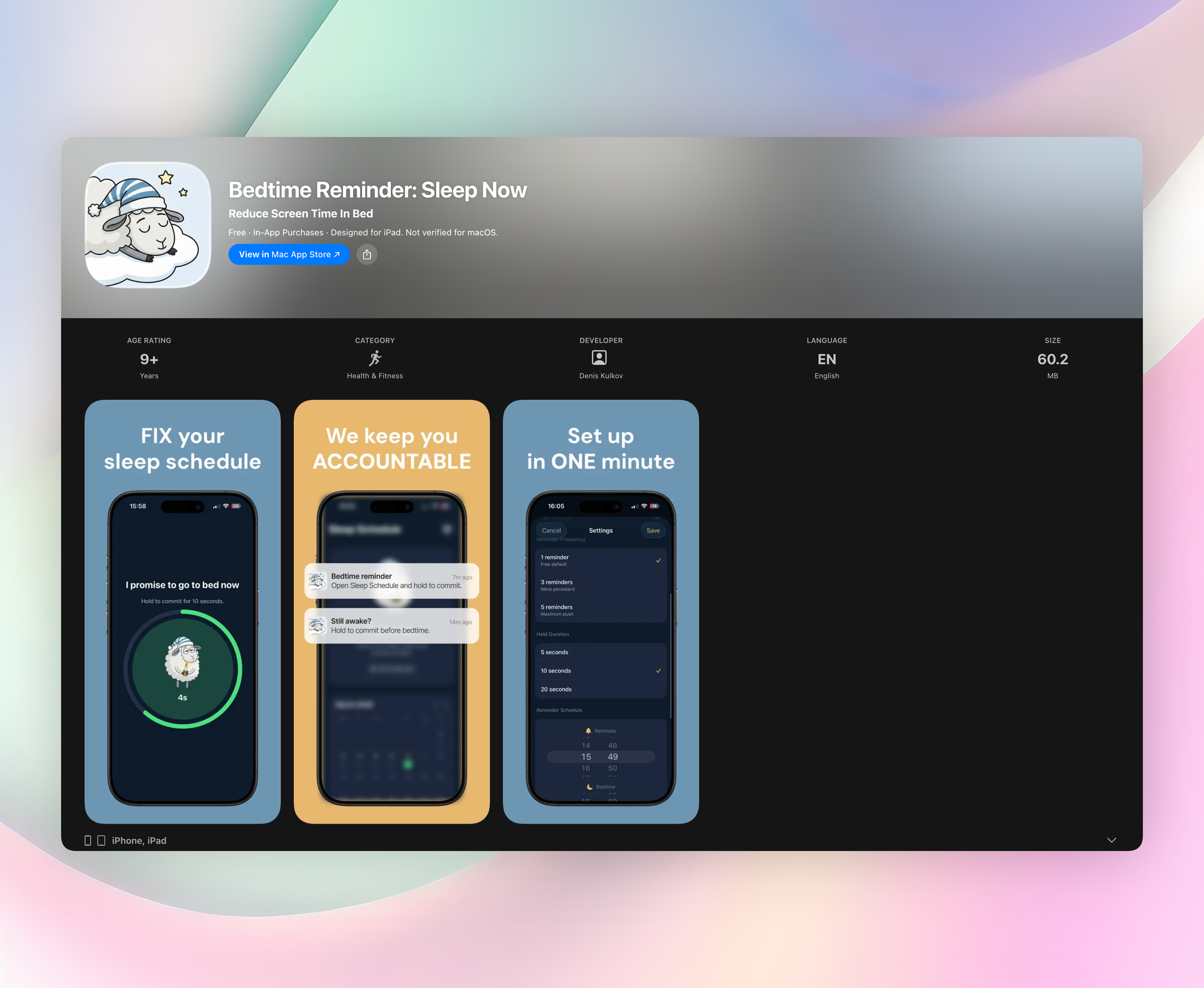
Bedtime is the hard half of the schedule because nothing enforces it — the wake time has an alarm behind it, the bedtime has whatever you're watching. A nudge shortly before lights-out, at the exact point you'd otherwise start one more episode, is what turns an intention into a time. Bedtime Reminder, a bedtime reminder app for iPhone, is built for that moment.
What a weekend lie-in repays, and what it doesn't
Sleeping in on weekends does real work. Two nights of extended sleep bring alertness and reaction time partway back — partway, not all the way, and the deeper the preceding restriction, the wider the gap left over. Mood and subjective energy respond fastest, which is the trap: you feel repaid well before you are.
The metabolic side moves slower. Short sleep pushes insulin sensitivity and appetite regulation the wrong way — more late-evening eating, blunted fullness signals — and a weekend of catch-up sleep has not been shown to return those markers to baseline. Worse, unrestricted weekend sleep shifts your body clock later, so the next week starts from a worse position than the last one did.
| What short sleep costs you | One long weekend lie-in | Several nights of +1–2 hours |
|---|---|---|
| Subjective sleepiness | Mostly resolves | Resolves |
| Reaction time, attention lapses | Partial recovery | Fuller recovery |
| Mood and irritability | Improves quickly | Improves and holds |
| Insulin sensitivity, appetite signals | Little repayment | Better, with consistency |
| Circadian timing | Pushed later | Preserved |
That last row is the one nobody accounts for.
Social jetlag: why the lie-in makes Monday worse
Social jetlag is the mismatch between your body's preferred sleep timing and your schedule's, measured as the difference in midsleep — the midpoint between falling asleep and waking — on free days versus work days. Sleep midnight to 8 on weekdays and your midsleep is 4 a.m. Sleep 1 a.m. to 10 a.m. on Saturday and it's 5:30. That's a 90-minute gap, and your physiology treats it something like flying a time zone and a half west every Friday and back every Sunday.
The mechanism is light. A late wake-up costs you the morning light that pulls your clock earlier and hands you more evening light, which pushes it later — both nudge your circadian rhythm the same way. By Sunday night your internal timing sits behind your alarm. The Sunday-night lying-awake and the Monday fog are a phase shift you built, not a mood.
Which is why the protocol below moves bedtime and leaves wake time alone.
The sleep debt recovery protocol
- Add the hour at the front end. Go to bed earlier rather than waking later. Same sleep, no clock shift.
- Cap the extension at one to two hours a night. Beyond that you'll mostly lie awake, because sleep pressure hasn't built enough to fill the extra time.
- Keep wake time within an hour of your weekday wake, and within 30 minutes if you can. This is the rule that separates recovery from a clock shift.
- Spread it over several nights. Deep sleep tends to rebound first, usually within a night or two; REM rebound follows over the nights after. One long Saturday buys only the first half of that sequence.
- Get outdoor light within half an hour of waking. It anchors the clock so the earlier bedtime is physically possible.
- Nap deliberately. Twenty minutes before mid-afternoon buys alertness without grogginess. A longer nap early in the afternoon repays more, at the cost of sleep pressure that night.
A few hours of debt clears in three or four nights of this. A month of running 90 minutes short takes a week or two of longer nights, and the metabolic repayment lags behind the alertness repayment. You'll know you're square when the extra sleep stops happening on its own — you wake before the alarm, at the earlier bedtime, without effort. That self-limiting quality is the most reliable signal there is.
Two honest limits. How to catch up on sleep is a smaller lever than not falling behind, so treat the protocol as an occasional repair rather than a weekly ritual. And if your schedule has drifted rather than shrunk — bed at 3 a.m., eight hours logged — that's resetting a shifted sleep schedule, a different job from repaying debt. Adequate time in bed and still flattened by mid-afternoon is worth raising with a doctor; more hours won't fix it.
FAQ
Can you catch up on sleep?
Partly, and only recent sleep. Extended sleep across several nights restores alertness and cognitive performance substantially, but metabolic markers recover slower and years of accumulated short sleep aren't repayable in any meaningful sense. Damage control, not a reset button.
How long does it take to recover from sleep debt?
A few hours of debt clears in three or four nights of an extra hour. A month of chronic restriction typically takes a week or two of longer nights, and some measures trail behind how you feel. The recovery is done when you stop naturally sleeping longer.
Is sleeping in on weekends bad for you?
An extra 30 to 60 minutes is harmless and probably useful. The damage starts around the two-to-three-hour mark, where the shift in timing costs you more on Monday than the extra sleep gained on Saturday. Cap the lie-in at about an hour past your weekday wake and take the rest at bedtime.
Do naps count toward paying off sleep debt?
They do — sleep is sleep. The caveat is timing: a nap late in the day borrows sleep pressure from that night, so you repay the debt in the afternoon and re-open it after midnight. Keep naps short and before mid-afternoon.
Can you bank sleep before a short night?
To a degree. Sleeping extra in the nights before one you know will be short reduces the deficit you end up carrying, and it's one form of prepayment that appears to work. It doesn't stack indefinitely, and it won't cover a week of four-hour nights.
Free Bedtime Reminder tools
- Best Nap Length CalculatorPlan the best nap length for your available window. Get a suggested nap start, alarm time and a warning if the window is too short.
- Calories Burned Sleeping CalculatorEstimate calories burned during sleep, calories per hour and the share of a full day's resting burn. Add age, sex and height for a BMR comparison.
- Melatonin Timing PlannerWondering how much melatonin should I take? Choose a target bedtime and reason to see the clock window used in studies and their published dose range, presented as reference rather than advice.
- Night Shift Sleep Schedule PlannerPlan a repeatable sleep, nap and wake schedule around night shifts. The planner keeps your requested total sleep duration while showing the timing it used.
- REM Sleep CalculatorEstimate where REM-heavy late-night sleep may fit in your schedule. Enter time asleep, sleep onset and wake-up time for a range, not a precise measurement.
- Sleep Cycle CalculatorUse this sleep calculator to plan bedtimes or wake-up times around 4, 5 or 6 sleep cycles. Add the minutes you usually need to fall asleep.
- Sleep Debt CalculatorCompare your usual sleep need with actual sleep from recent nights. See total sleep debt or surplus, a nightly breakdown and an optional gradual recovery target.
- Sleep Efficiency CalculatorEnter time in bed and estimated time asleep to calculate sleep efficiency as a percentage and see the awake-time gap.
- Sleep Needs CalculatorFind how many hours of sleep you need by age, see the recommended nightly range, and work back to a bedtime from your wake-up time.
- Sleep TimerSet a sleep timer for 15 to 90 minutes or choose a custom duration. The low-glare countdown stays in your browser and can end with a gentle chime.
- White Noise GeneratorGenerate continuous white, pink or brown noise in your browser. Play it while you sleep, adjust the volume and optionally set a timer with a gentle fade-out.