
Delayed sleep phase syndrome, or just a late chronotype?
Delayed sleep phase syndrome is a circadian rhythm disorder in which the body clock runs two or more hours later than the schedule a person has to keep. It isn't preference or weak discipline. Being a night owl is normal variation; the disorder is what happens when that timing won't move.
What delayed sleep phase syndrome actually describes
Sleep medicine's current name for it is delayed sleep-wake phase disorder, filed with the other circadian rhythm sleep disorders — advanced phase, non-24-hour, shift work, jet lag. Both terms describe the same picture: a clock stably set late relative to the day the person has to live.
The sleep itself is usually normal — 3 a.m. to 11 a.m. can be a perfectly good night. The trouble is the gap between that and an 8 a.m. obligation. Which is why it gets misread: someone who lies awake until 4 a.m. and then can't be woken looks like an insomniac with bad habits.
Underneath, the human pacemaker runs on an intrinsic period slightly longer than 24 hours, reset each day mostly by light — the mechanism behind how the circadian clock stays anchored. When the phase is delayed, the evening rise in melatonin arrives hours later than in an average sleeper. The pattern usually appears in adolescence and tends to run in families.
Night owl vs early bird: where chronotype ends and a disorder begins
Chronotype describes where someone falls on the morning-to-evening spectrum. Evening types are a substantial minority of adults — the share moves with the questionnaire used, but roughly a fifth is the usual ballpark. Late timing by itself is not pathology. The line gets drawn by rigidity and by cost.
| Marker | Late chronotype | Delayed sleep-wake phase disorder |
|---|---|---|
| Sleep onset left alone | Midnight to 1–2 a.m. | Usually 2–6 a.m., stable night after night |
| Trying to sleep two hours earlier | Uncomfortable, workable in a week or two | Hours of lying awake; onset barely moves |
| Mornings | Groggy, clears in 30–60 minutes | Prolonged sleep inertia, or failed alarms |
| Sleep on a free schedule | Normal | Normal quality and length; timing is wrong |
| Persistence | Lifelong tendency, some give in it | Months or years, usually since the teens |
| Cost | Manageable social jet lag | Weekday sleep loss, missed work, distress |
Clinical criteria formalize that last column: a delay relative to the required schedule, present at least three months, sleep that normalizes once the person picks their own hours, and a sleep diary or wearable record covering a week of both work and free days.
The markers that separate the two
What a free week looks like. Everyone drifts later on vacation. The tell is the shape of the drift — a late type's timing wanders with opportunity; a delayed clock settles on the same late hours with unusual precision.
What happened the last time they tried. A late type who commits to a fixed early wake time and morning light generally holds the new schedule inside a couple of weeks. A delayed clock gives you weeks of lying awake at the new bedtime and no movement in when sleep actually starts. That failure pattern is the most useful signal there is — it's why shifting a sleep schedule that keeps snapping back deserves more than the usual advice about screens.
The size of the weekday gap. Compare mid-sleep on free days with mid-sleep on work days. Two hours apart is ordinary social jet lag; four or more, sustained, means the weekday schedule is being paid for in accumulated sleep debt.
None of that is a diagnosis. A delay that costs you school, work, or health is a reason to see a clinician rather than run a protocol off a blog — the pattern gets mistaken for insomnia or depression, and the wrong label produces the wrong plan.
What actually shifts a delayed clock earlier
What follows is general circadian sleep-hygiene, not a treatment plan for a diagnosed disorder — the same logic behind jet-lag and shift-work advice. A clinician should set the exact timing and melatonin dose for a confirmed diagnosis. Circadian timing responds to a short list of inputs, and the order matters more than how hard anyone tries.
Hold the wake time first
The clock entrains to what happens after you get up — light, movement, food — far more than to when you got into bed. A wake time that holds seven days a week is the foundation. Sleeping in Saturday and Sunday hands back most of the week's progress, since two mornings of late light are themselves a delaying signal.
Get morning light on the right side of the curve
Light doesn't shift the clock in one direction. It advances the clock when it lands after the body's temperature minimum — roughly a couple of hours before habitual wake time — and delays it when it lands before. For someone whose natural wake time is 11 a.m., a 6 a.m. light session can land on the wrong side of that line and push the clock later still.
So start light at your current spontaneous wake time, outdoors if you can, and move wake time and light 15 to 20 minutes earlier every couple of days. Outdoor daylight runs to thousands of lux even under cloud; indoor lighting is an order of magnitude weaker. Twenty to sixty minutes, eyes open, no sunglasses.
Take the evening light down
Evening light does the opposite job. What matters is total light reaching the eye in the last two to three hours before bed, not just screens — dimming the room beats putting a filter on a phone held at arm's length.
Timed melatonin is a clinician conversation
Melatonin's phase-response curve runs roughly opposite to light's: taken in the hours before your own melatonin would naturally rise, it can advance the clock. Timing does more work than dose, and the amounts used clinically for phase shifting are small — well below what's sold as a sleep aid. It isn't acting as a sedative here. Because effective timing depends on where your circadian phase sits, this is the step to bring to a doctor rather than improvise.
Move the target in 15-minute steps
The clock advances by up to about an hour a day under ideal conditions, usually less. Fifteen to twenty minutes every two or three days is the sustainable rate, and holding a new phase is harder than reaching it.
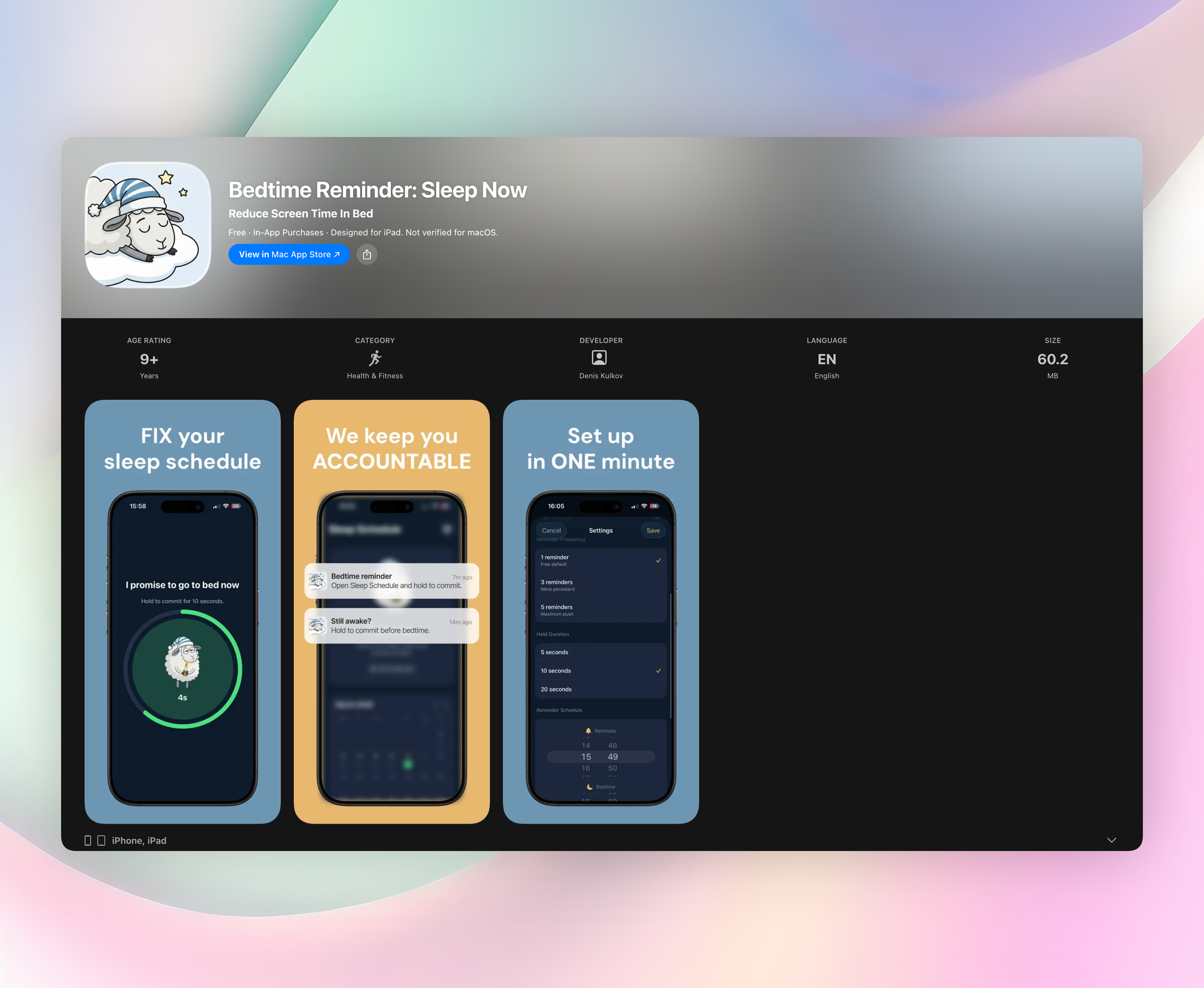
Every cue in that sequence is defined against a bedtime that keeps moving — dim the lights two hours before it, wind down an hour before it, hold the wake time on the far side of it. That's what people lose track of by week three, since the target is never a fixed clock time. Bedtime Reminder is a bedtime reminder app for iPhone, which is enough to keep the moving target in front of you while you step it back.
The realistic ceiling
A phase can be shifted. A person can't be converted. Intrinsic period and genetics set a floor under how early your clock will comfortably sit, and pushing against it is a daily maintenance cost — the light and the fixed wake time have to keep happening, or the phase drifts back within a week of late nights.
What's realistically available is an hour or two, held with consistency. Often that's enough to turn a 9 a.m. start from impossible into merely unpleasant. It won't make a 5:30 a.m. gym habit feel natural, and treating that as the goal is how people decide the whole effort failed. Where the schedule itself can move — a later start, remote work — that's the higher-yield change.
FAQ
Is delayed sleep phase syndrome the same as insomnia?
No. In insomnia, sleep is hard to get or hold regardless of when it's attempted. In a delayed phase, sleep comes easily and is of normal quality — just hours later than wanted. The overlap is that trying to sleep at a conventional hour produces real sleep-onset insomnia, which is how the two get confused.
What is my chronotype, and how do I find out?
The practical measure is your mid-sleep point on free days — the midpoint between falling asleep and waking with no alarm, after a few days of catching up. Questionnaires like the Morningness-Eveningness Questionnaire formalize it, but two weeks of a sleep diary gets you most of the answer.
Can a night owl sleep schedule be changed permanently?
It can be shifted and held, but only with the inputs kept up indefinitely. Morning light and a fixed wake time aren't a course you complete; they're the conditions that keep the new phase in place. Stop for a week of late nights and the clock drifts back.
Does a delayed clock get earlier with age?
Usually. Circadian timing runs latest in the late teens and early twenties, then drifts earlier across adulthood, which is why the problem eases on its own for some people in their thirties. It doesn't remove the underlying tendency — a late type at 45 is still late relative to peers.
Free Bedtime Reminder tools
- Best Nap Length CalculatorPlan the best nap length for your available window. Get a suggested nap start, alarm time and a warning if the window is too short.
- Calories Burned Sleeping CalculatorEstimate calories burned during sleep, calories per hour and the share of a full day's resting burn. Add age, sex and height for a BMR comparison.
- Melatonin Timing PlannerWondering how much melatonin should I take? Choose a target bedtime and reason to see the clock window used in studies and their published dose range, presented as reference rather than advice.
- Night Shift Sleep Schedule PlannerPlan a repeatable sleep, nap and wake schedule around night shifts. The planner keeps your requested total sleep duration while showing the timing it used.
- REM Sleep CalculatorEstimate where REM-heavy late-night sleep may fit in your schedule. Enter time asleep, sleep onset and wake-up time for a range, not a precise measurement.
- Sleep Cycle CalculatorUse this sleep calculator to plan bedtimes or wake-up times around 4, 5 or 6 sleep cycles. Add the minutes you usually need to fall asleep.
- Sleep Debt CalculatorCompare your usual sleep need with actual sleep from recent nights. See total sleep debt or surplus, a nightly breakdown and an optional gradual recovery target.
- Sleep Efficiency CalculatorEnter time in bed and estimated time asleep to calculate sleep efficiency as a percentage and see the awake-time gap.
- Sleep Needs CalculatorFind how many hours of sleep you need by age, see the recommended nightly range, and work back to a bedtime from your wake-up time.
- Sleep TimerSet a sleep timer for 15 to 90 minutes or choose a custom duration. The low-glare countdown stays in your browser and can end with a gentle chime.
- White Noise GeneratorGenerate continuous white, pink or brown noise in your browser. Play it while you sleep, adjust the volume and optionally set a timer with a gentle fade-out.