
Revenge bedtime procrastination: why you stay up and how to stop
Revenge bedtime procrastination is delaying sleep on purpose, with nothing stopping you, to reclaim leisure time your day didn't leave room for. It isn't insomnia — you can fall asleep fine, you just don't go. The fix is structural, not a matter of trying harder at midnight.
What revenge bedtime procrastination actually is
The behavior has three parts: you go to bed later than intended, nothing external forces the delay, and you know while it's happening that tomorrow will be worse for it — close to the definition researchers use, failing to go to bed at the intended time when no outside circumstance prevents you.
A parent up with a sick kid isn't procrastinating — they're occupied.
The "revenge" part arrived later, from the Chinese phrase 报复性熬夜 — retaliatory staying up late — which spread through English sleep writing around 2020. It names the motive rather than the behavior. When your waking hours belong to a job, a commute, and other people's needs, the hours after bedtime are the only ones nobody has claimed, and staying up is how you take some back. (Plenty of people search this as reverse bedtime procrastination, the same pattern under a garbled name.)
Revenge bedtime procrastination vs. insomnia
They get confused constantly — from outside, the result looks identical: too little sleep, a rough morning. The mechanisms are opposite: one is not going to bed, the other is being in bed and not sleeping.
| Revenge bedtime procrastination | Insomnia | |
|---|---|---|
| What's blocked | Getting into bed | Falling or staying asleep |
| Time to fall asleep once in bed | Usually short — often minutes | Prolonged, or repeated wakings |
| The night feels like | Absorbing, then abrupt | Frustrating, effortful |
| Attitude toward bed | Avoidance, mild reluctance | Dread, pressure to perform |
| Weekends and vacations | Often improves — the day gave time back | Frequently persists |
| Where to start | The two hours before bed | A clinician, since sleep itself is the problem |
The check is simple: if you're in bed at your target time and out inside fifteen minutes, sleep isn't your problem — the hour before bed is. If you lie awake anyway several nights a week, that's a doctor's problem, not a habit fix.
Why do I procrastinate going to bed after the hardest days
The pattern has a shape that surprises people: it's worst after your most demanding days — long meetings, a difficult customer, work you'd rather not have done. The theory usually cited is the strength model of self-control — regulating yourself all day leaves less in reserve for the evening. Stated honestly, the lab evidence for that depletion effect has taken serious hits in replication attempts, so treat the mechanism as unsettled. The pattern itself is easy to verify against your own week.
Sleep is cheap to sacrifice in the moment: skipping a workout costs you something now, skipping ninety minutes of sleep costs nothing until the next afternoon.
Then there's autonomy. If other people scheduled your day start to finish, the evening is the first stretch you control — going to bed on time can feel like handing back the last unsupervised hour. That's why "just go to bed earlier" lands badly: one more instruction aimed at the only part of the day that wasn't.
Why willpower at 11pm is the wrong tool
Your circadian system doesn't ramp sleepiness up smoothly through the evening. In the couple of hours before your habitual bedtime, the clock's alerting signal sits near its daily peak — sleep researchers call it the wake maintenance zone — pushing back hardest just as sleep pressure peaks. You can genuinely feel less sleepy at 10:30 than at 8:30 — exactly when you're expected to make a disciplined choice.
There's also no single choice to make. Nobody decides to stay up until 1am; you decide on one more episode at 11:04, then another at 11:52. Feeds and autoplay are built without endpoints, so it never ends on its own. Willpower needs a decision point; the evening's design removes it. So the answer isn't more discipline — the choice has to be made earlier, by a version of you who isn't in the wake maintenance zone with a warm screen.
How to stop revenge bedtime procrastination
Defend the start of the wind-down, not lights-out
"Be asleep by 11" isn't an instruction you can follow — it's an outcome. "Stop what you're doing at 10:20" is something you can actually do. Move the commitment to the front — that's the only point where a decision exists.
The obstacle is that nothing marks it: work has meetings, mornings have alarms, but the evening just continues until you notice the time. That's what an external prompt is for, and it's the first thing to set up. Bedtime Reminder is a bedtime reminder app for iPhone; the useful part is that the prompt arrives at an hour you picked in advance rather than one you renegotiate at 11pm.
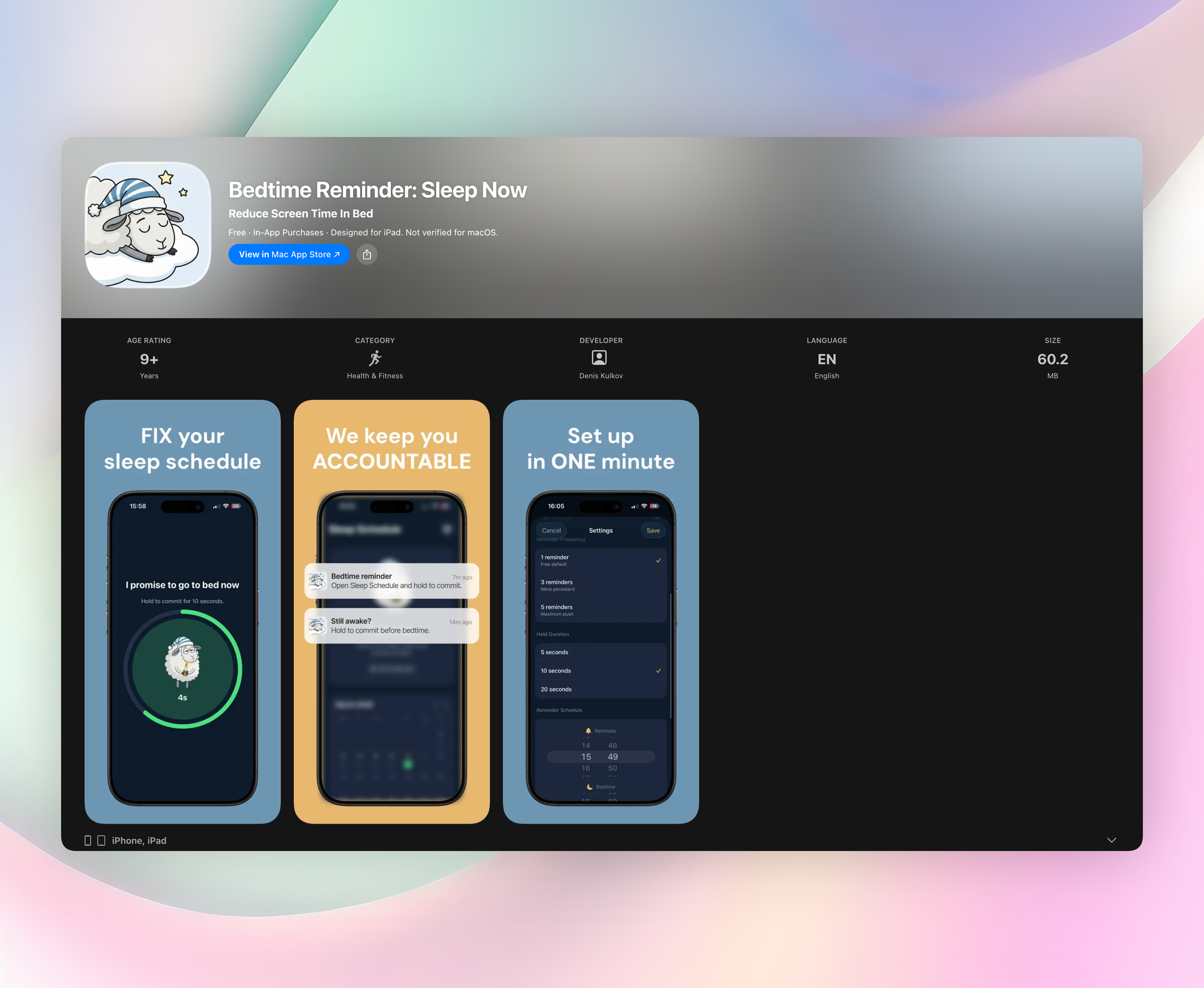
Set it for the wind-down start, not the moment you want to be unconscious, and keep it within about an hour on weekends — a consistent sleep schedule does more here than any single night's effort.
Move the leisure earlier instead of deleting it
The need underneath this is legitimate — unclaimed time isn't a luxury, and an evening with none of it is why the night gets raided. Deleting the leisure outright usually backfires — there's nothing left to replace what got cut.
Relocate it instead: take the hour at 8pm and protect it like a meeting. When part of the evening genuinely belongs to you, the hours after bedtime stop being the only place to find any.
Remove the specific default you drift into
It's rarely "screens" in general. It's one app, one show, one game — a single default you fall into when nothing else is scheduled. Name it precisely, then put friction on that one thing, not the whole evening. Log out of the one app. Turn off autoplay. Leave the controller in a drawer. Broad rules like "no screens after 9" collapse because they ask for a hundred small refusals; removing one default asks for one.
Separate the drift from the clock
If this has already pushed your nights hours later, a wind-down alarm won't drag them back on its own. Fixing a shifted sleep schedule works on timing; everything above works on the decision. And a run of short nights leaves sleep debt that one long Saturday won't clear.
When it stops being a habit problem
If you're in bed at a reasonable hour and still awake an hour later, several nights a week for a month or more, that's not procrastination. Same if daytime sleepiness affects your driving or your work, or if you sleep enough hours and still wake unrefreshed. Raise those with a doctor.
FAQ
Is revenge bedtime procrastination a real diagnosis?
No. It's a behavioral pattern described in sleep and self-regulation research, not a clinical condition — which doesn't make it harmless, since the sleep loss is as real as any other kind.
Why do I stay up late even when I'm exhausted?
Tired and sleepy aren't the same state. A demanding day produces fatigue, not sleep pressure, and the circadian alerting signal works against you before your usual bedtime. You end up depleted enough to want escape and alert enough to stay awake for it.
Is reverse bedtime procrastination the same thing?
Yes. It's a common misremembering of "revenge," and people searching it mean the same behavior: staying up past a bedtime nothing was preventing you from keeping.
How long does it take to stop feeling like a fight?
There's no reliable number — anyone quoting one is guessing. A fixed wind-down start usually feels automatic within a couple of weeks. If you're also moving bedtime earlier, shift it in 15–20 minute steps — a full hour jump usually ends in lying awake.
Does putting my phone in another room actually help?
It helps only as much as the phone is the problem. If your drift is scrolling in bed, removing the device removes the decision — get a cheap alarm clock so you're not reaching for it at 7am. If the drift is television or gaming, the phone rule changes nothing.
Free Bedtime Reminder tools
- Best Nap Length CalculatorPlan the best nap length for your available window. Get a suggested nap start, alarm time and a warning if the window is too short.
- Calories Burned Sleeping CalculatorEstimate calories burned during sleep, calories per hour and the share of a full day's resting burn. Add age, sex and height for a BMR comparison.
- Melatonin Timing PlannerWondering how much melatonin should I take? Choose a target bedtime and reason to see the clock window used in studies and their published dose range, presented as reference rather than advice.
- Night Shift Sleep Schedule PlannerPlan a repeatable sleep, nap and wake schedule around night shifts. The planner keeps your requested total sleep duration while showing the timing it used.
- REM Sleep CalculatorEstimate where REM-heavy late-night sleep may fit in your schedule. Enter time asleep, sleep onset and wake-up time for a range, not a precise measurement.
- Sleep Cycle CalculatorUse this sleep calculator to plan bedtimes or wake-up times around 4, 5 or 6 sleep cycles. Add the minutes you usually need to fall asleep.
- Sleep Debt CalculatorCompare your usual sleep need with actual sleep from recent nights. See total sleep debt or surplus, a nightly breakdown and an optional gradual recovery target.
- Sleep Efficiency CalculatorEnter time in bed and estimated time asleep to calculate sleep efficiency as a percentage and see the awake-time gap.
- Sleep Needs CalculatorFind how many hours of sleep you need by age, see the recommended nightly range, and work back to a bedtime from your wake-up time.
- Sleep TimerSet a sleep timer for 15 to 90 minutes or choose a custom duration. The low-glare countdown stays in your browser and can end with a gentle chime.
- White Noise GeneratorGenerate continuous white, pink or brown noise in your browser. Play it while you sleep, adjust the volume and optionally set a timer with a gentle fade-out.