
How to wake up early without cutting your sleep short
The short version of how to wake up early: move your wake time and bedtime earlier together in 15-minute steps, holding each step for two or three days. Get bright light within 30 minutes of the new wake time. An earlier alarm on its own doesn't shift anything — it shortens sleep.
Why an earlier alarm on its own fails
An alarm controls one end of the night. Your circadian system controls the other, and it doesn't take instructions.
Melatonin release typically begins about two hours before habitual sleep onset. The stretch just before that is the hardest window of the day to fall asleep — sleep researchers call it the wake maintenance zone. Someone whose body expects sleep at midnight, lying down at 10:30 p.m., is lying down inside that zone and will still be awake at 11:20.
So the alarm moves to 6:00 a.m., bedtime doesn't budge, and you get a 90-minute deficit instead of a 90-minute shift. The deficit compounds within days, one long Saturday drags the clock back, and the failure gets filed under discipline when it was arithmetic — the most common way an attempt to fix a sleep schedule collapses.
How to wake up early in 15-minute steps
To wake up earlier and keep it, both ends of the night move at once, in increments small enough that the clock follows without a fight.
- Measure the real baseline. For a week, note when you actually fall asleep, not when you get into bed. Most people underestimate that gap.
- Count the steps. A 7:30 a.m. wake to 6:00 a.m. is six steps of 15 minutes — two to three weeks at two to three days each.
- Move both ends on the same day, so total sleep time never changes.
- Hold until the step feels neutral: asleep within about 20 minutes, awake without the alarm feeling like an assault. Two neutral days, then advance.
- Don't hand the weekend back. Sleeping in more than an hour past your current step undoes several days of work.
| Step | Bedtime | Wake time | Hold for |
|---|---|---|---|
| Baseline | 12:00 a.m. | 7:30 a.m. | one week |
| 1 | 11:45 p.m. | 7:15 a.m. | 2–3 days |
| 2 | 11:30 p.m. | 7:00 a.m. | 2–3 days |
| 3 | 11:15 p.m. | 6:45 a.m. | 2–3 days |
| 4 | 11:00 p.m. | 6:30 a.m. | 2–3 days |
| 5 | 10:45 p.m. | 6:15 a.m. | 2–3 days |
| 6 | 10:30 p.m. | 6:00 a.m. | permanent |
Sleep duration stays at seven and a half hours in every row. You're relocating the night, not trimming it.
Morning light is what locks each step in
Light is the clock's main cue, and its timing decides which way the clock moves. Light after your core body temperature minimum — roughly two to three hours before habitual wake time — pulls it earlier; light in the late evening, before that low point, pushes it later. Same brightness, opposite effect. The mechanics deserve a full explainer on the circadian rhythm.
In practice: outdoors, within 30 minutes of waking, 10 to 20 minutes, no sunglasses. It has to be outdoors: typical indoor lighting sits in the low hundreds of lux, an overcast morning outside is already in the thousands, and clear open sky is an order of magnitude past that. A closed window strips out a large share.
If your wake time lands before sunrise — normal in winter, unavoidable for anyone targeting 5 a.m. — switch on the brightest indoor lighting you have and get outside as soon as there's daylight. Weaker cue, but the alternative is a step that never consolidates. Evenings do the reverse: dim the house for the two hours before the new bedtime, as part of the step.
Protecting the bedtime end
The wake side of each step enforces itself. The bedtime side has to be defended.
- Caffeine's half-life runs around five hours in most adults, longer in some. Move your cutoff 15 minutes earlier with every step.
- Alcohol shortens the time it takes to fall asleep, then fragments the back half of the night — the half you're relocating.
- Naps past about 20 minutes, or later than mid-afternoon, bleed off the sleep pressure the new bedtime depends on.
- Hard training close to bed raises core temperature when it should be falling.
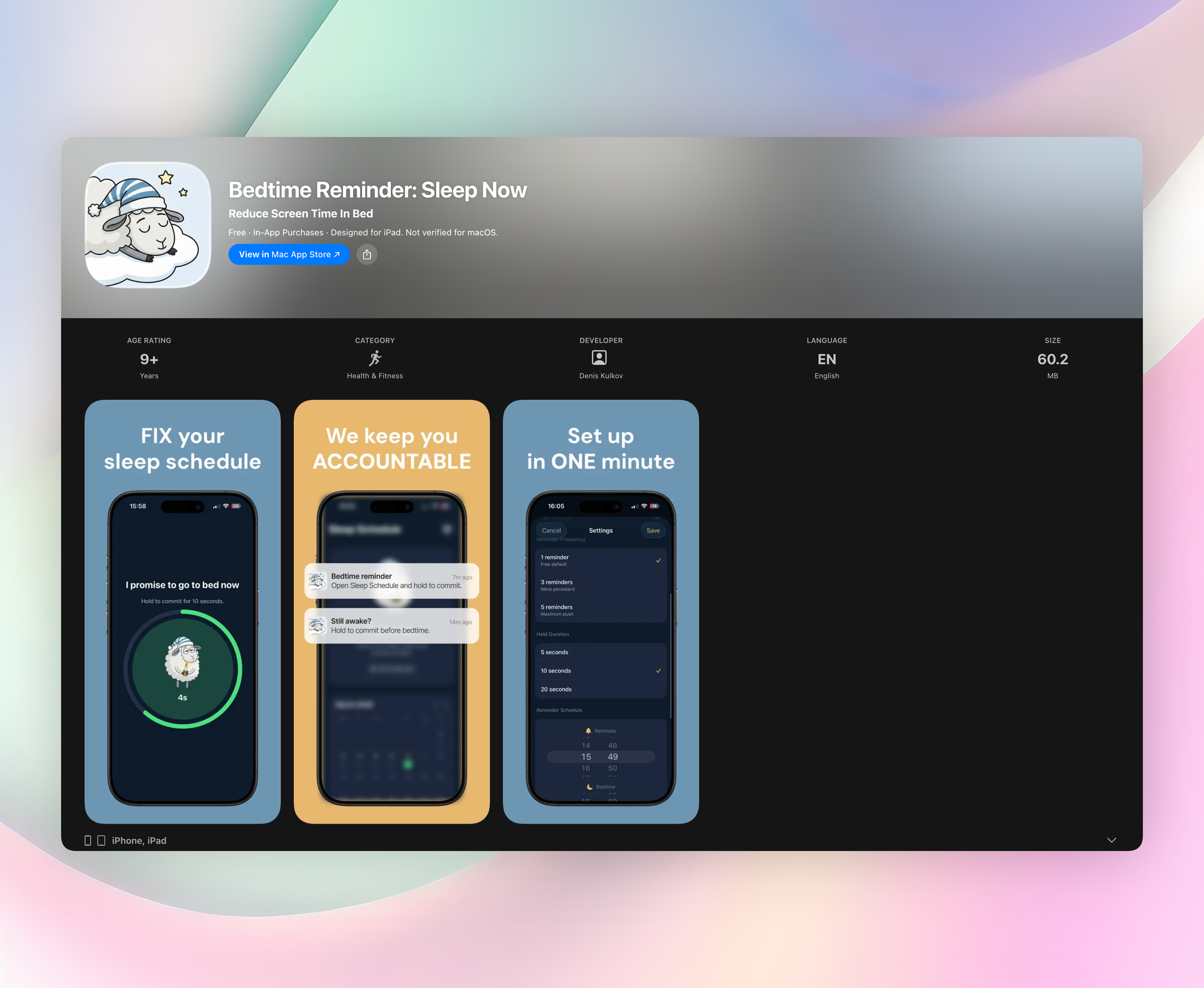
Nothing goes off at 11:15 p.m. to announce the step changed — the alarm covers the morning, the evening runs on memory, and that's where these plans quietly come apart. Bedtime Reminder, a bedtime reminder app for iPhone, covers that half: you set the new time each step and it reminds you. That matters most in weeks two and three, once the novelty is gone.
What to do when a step stalls
Some steps won't take. Hold, don't push.
- Awake more than 30 minutes at the new bedtime two nights running: stay on the step a few more days.
- Three bad nights: drop back one step, hold a week, try again.
- Never patch a stall by moving bedtime alone — that's the alarm-only mistake, mirrored.
- Illness, travel, a late night out: hold the step rather than restarting. One bad night costs a day, not the plan.
Wake time is the anchor throughout. Even after going to bed two hours late, get up at the step's wake time; the sleepiness that follows pulls the next night's onset earlier.
Morning person vs night owl: how far you can actually shift
Chronotype has a real genetic component, and the intrinsic period of the human clock averages slightly more than 24 hours. That bias is why staying up late is effortless and learning to go to bed earlier is not — you're working against the drift, not with it.
Most people can move a whole schedule one to two hours earlier and hold it, provided weekends stay within an hour of weekdays. Three hours or more is achievable but slower and forgives nothing. The weekday-to-weekend gap has a name — social jet lag — and it's what resets shifts people spent weeks building. Wanting to be a morning person and being one are separated mostly by light timing and weekend consistency.
Whether a night owl can become a morning person has an honest answer: the schedule moves and mornings stop being awful, but the late-leaning tendency doesn't disappear. Going from a 2 a.m. natural onset to a stable 11:30 p.m. is a real result; feeling alert at 5 a.m. with no light and no fixed wake time is not.
If onset sits at 3 or 4 a.m. regardless of what you try, and every attempt to advance stalls inside a week, that pattern is what's described as delayed sleep phase — worth raising with a clinician rather than applying more willpower. General sleep-hygiene advice, this article included, isn't a substitute for that.
FAQ
How long does it take to wake up early consistently?
For a 60- to 90-minute shift, plan on two to three weeks of steps and another two weeks before the new time feels automatic. Stepping is the fast part; consolidation is where people quit early.
How do I wake up at 5am if I currently get up at 8?
That's a three-hour move — twelve 15-minute steps, roughly five weeks. Bedtime has to land near 9:30 p.m. for a seven-and-a-half-hour night, which is the part people underestimate. Move the alarm without moving bedtime and you're running a deficit, not a shift.
Can I force the whole shift in one day?
You can force a wake time; you can't force sleep onset. One hard morning plus an early night can reset a gap under an hour. Anything larger usually produces a short night, a long nap, and a rebound within a week.
Does sleeping in on weekends undo the progress?
An extra hour is tolerable. Two or more pushes the clock back, and you'll spend Monday and Tuesday re-earning steps you already paid for. If you're short on sleep, a 20-minute early-afternoon nap costs far less than two extra hours in the morning.
Should I go to bed earlier first, then move the alarm?
Neither first — both on the same night. Moving bedtime alone means lying awake in the wake maintenance zone; moving the alarm alone means less sleep.
Free Bedtime Reminder tools
- Best Nap Length CalculatorPlan the best nap length for your available window. Get a suggested nap start, alarm time and a warning if the window is too short.
- Calories Burned Sleeping CalculatorEstimate calories burned during sleep, calories per hour and the share of a full day's resting burn. Add age, sex and height for a BMR comparison.
- Melatonin Timing PlannerWondering how much melatonin should I take? Choose a target bedtime and reason to see the clock window used in studies and their published dose range, presented as reference rather than advice.
- Night Shift Sleep Schedule PlannerPlan a repeatable sleep, nap and wake schedule around night shifts. The planner keeps your requested total sleep duration while showing the timing it used.
- REM Sleep CalculatorEstimate where REM-heavy late-night sleep may fit in your schedule. Enter time asleep, sleep onset and wake-up time for a range, not a precise measurement.
- Sleep Cycle CalculatorUse this sleep calculator to plan bedtimes or wake-up times around 4, 5 or 6 sleep cycles. Add the minutes you usually need to fall asleep.
- Sleep Debt CalculatorCompare your usual sleep need with actual sleep from recent nights. See total sleep debt or surplus, a nightly breakdown and an optional gradual recovery target.
- Sleep Efficiency CalculatorEnter time in bed and estimated time asleep to calculate sleep efficiency as a percentage and see the awake-time gap.
- Sleep Needs CalculatorFind how many hours of sleep you need by age, see the recommended nightly range, and work back to a bedtime from your wake-up time.
- Sleep TimerSet a sleep timer for 15 to 90 minutes or choose a custom duration. The low-glare countdown stays in your browser and can end with a gentle chime.
- White Noise GeneratorGenerate continuous white, pink or brown noise in your browser. Play it while you sleep, adjust the volume and optionally set a timer with a gentle fade-out.