
How to fall asleep fast: four methods and what they do
Most advice on how to fall asleep fast skips the mechanism. The four techniques worth knowing — the military method, 4-7-8 breathing, cognitive shuffling, and a body scan — each do one of three things: slow your breathing, occupy the verbal loop, or drop physical arousal. Expect 10–20 minutes, not seconds.
How to fall asleep fast: what "fast" actually means
Healthy sleepers take roughly 10 to 20 minutes to drop off. That interval is called sleep onset latency, and shorter isn't automatically better — consistently going under in less than five minutes usually signals accumulated sleep debt rather than skill.
The number matters because of the trap sitting underneath every technique here: sleep effort. The harder you push for sleep, the more you check whether it's working, and checking is an alerting task. Each method below works partly by handing your attention a job that isn't "am I asleep yet." Give any of them a week before judging it — for the first few nights the novelty of the procedure keeps you awake by itself.
The military sleep method: relax the body in a fixed order
The routine traces to Relax and Win, a 1981 book by track coach Lloyd "Bud" Winter, which described a relaxation drill taught to naval aviation cadets. Lying on your back:
- Release your face — forehead, eyelids, the muscles around your eyes, jaw, tongue. Jaw and tongue are where most people hold tension without noticing.
- Drop your shoulders as far as they'll go. Let one arm go heavy from shoulder to fingertips, then the other.
- Exhale, and let your chest sink with the breath.
- Release your legs one side at a time — thigh, calf, foot.
- Spend about ten seconds emptying your head. Winter's version supplies a fixed image to hold instead: a canoe on a still lake, or a black hammock in a completely dark room. If images slide away, repeat "don't think" slowly.
Two honest corrections. The often-quoted claim about how many pilots learned it comes from that book, not a controlled study — treat it as an anecdote. And the version circulating as how to fall asleep in 10 seconds misreads the source: the ten seconds is the final mind-clearing step at the end of the sequence, and the original claim assumed roughly six weeks of nightly practice.
Mechanically this is progressive muscle relaxation without the tense-first half. Unclenching a muscle group on purpose cuts the low-level motor traffic that keeps the nervous system on standby. Pick it when the problem is physical — tight jaw, restless legs, a chest that won't settle.
4-7-8 breathing: make the exhale longer than the inhale
Popularized by physician Andrew Weil and adapted from pranayama, this one is a fixed ratio, not a fixed speed.
- Rest the tip of your tongue on the ridge behind your upper front teeth and leave it there.
- Empty your lungs through your mouth.
- Inhale quietly through the nose for a count of 4.
- Hold for 7.
- Exhale through the mouth, lips slightly pursed, for a count of 8.
That's one cycle. Four is a full round — Weil caps it there, especially in the first weeks, since extra cycles are more likely to leave you lightheaded than more relaxed.
The ratio does the work. A full-length cycle runs about 19 seconds — near three breaths a minute, far under a normal resting rate. An exhale longer than the inhale raises parasympathetic (vagal) activity, and heart rate dips slightly during exhalation, so stretching that phase pulls the whole pattern down with it. If holding for 7 makes you tense, halve every count and keep the shape: 2-3.5-4.
A couple of caveats apply. Breathwork lowers arousal but doesn't sedate, so it helps when you're keyed up after an argument and does little when you're mentally drafting tomorrow. And if breath-holding itself feels unpleasant, drop the hold entirely — in for 4, out for 6.
Cognitive shuffling: give the verbal loop nonsense to chew on
The technique comes from cognitive scientist Luc Beaudoin, who calls it serial diverse imagining. It's built for the night your body is fine and your head won't stop.
- Pick a neutral seed word. "Bedtime" works.
- Take its first letter — B — and think of a concrete, unrelated object: bicycle. Hold the picture a few seconds. Then bread. Then bottle. Then balcony.
- When that letter dries up, move to the next: E — envelope, elephant, escalator.
- Two rules: concrete objects only, and no story connecting them. Skip anything loaded, like a coworker's name or an unpaid bill.
Rumination needs coherent sequential thought — planning, rehearsing, replaying. A stream of unrelated images occupies the same mental workspace while refusing to organize into a narrative, so the loop starves. It also imitates hypnagogia, the loose drifting imagery that appears naturally as you tip into sleep. For racing thoughts at night this is the strongest of the four, because it competes with the thoughts directly instead of working around them.
Body scan for sleep: move attention, don't order yourself to relax
Start at the toes of one foot. Notice what's actually there — warmth, pressure, the weight of the duvet, or nothing — for 20 to 60 seconds. Then move up in small regions — foot, ankle, calf, knee, thigh, the other leg, hips, torso, arms, neck, face. Don't try to relax anything; noticing is the whole instruction. When you catch yourself thinking, return to the last region you remember.
A slow pass takes 10 to 15 minutes, and reaching your scalp still awake isn't failure — turn around and go back down. This works on two fronts: attention to the body competes with verbal rumination for the same limited resource, and because success means noticing rather than sleeping, the checking loop has nothing to check.
Which method fits which problem
| Method | Use it when | What it targets | Time |
|---|---|---|---|
| Military method | Tight jaw, restless legs, body wired | Muscle tension, motor arousal | 2–5 min |
| 4-7-8 breath cycle | Heart still going after a late screen or argument | Breathing rate, autonomic arousal | 4 cycles, 1–2 min |
| Cognitive shuffle | Replaying conversations, drafting tomorrow's list | The verbal working-memory loop | 5–15 min |
| Body scan | Both at once, or you can't tell which | Attention, plus residual tension | 10–15 min |
Stacking is fine: four cycles of 4-7-8 to take the edge off, then shuffle letters until you lose track of them.
What to do if you're still awake 20 minutes later
Lying in bed awake trains your brain that bed is a place for being awake. The countermeasure is the quarter-hour rule: once you've been awake around 15 to 20 minutes and frustration is setting in, leave the bedroom, keep the light low, do something dull and non-glowing — a paperback, folding laundry — and come back when your eyes get heavy. Repeat as often as it takes.
Estimate those 20 minutes, don't measure them. Turn the clock away, because arithmetic about how much sleep is left is an alerting task of its own. The rest of the setup — dark, cool, quiet, and a wind-down that starts before you're in bed — sits in the sleep hygiene rules.
The boring lever that beats all four: a fixed sleep window
Techniques work at the margin; timing sets the baseline. If your bedtime swings two hours across a week, your circadian system never settles on a phase, and you spend part of every night waiting on a sleep drive that hasn't arrived. A fixed wake time anchors that phase more firmly than a fixed bedtime does — back-calculate lights-out from it and hold both inside about half an hour, weekends included. Building a consistent sleep schedule is what makes the four methods above look effective, and if yours has already drifted late, move it earlier gradually rather than in one jump.
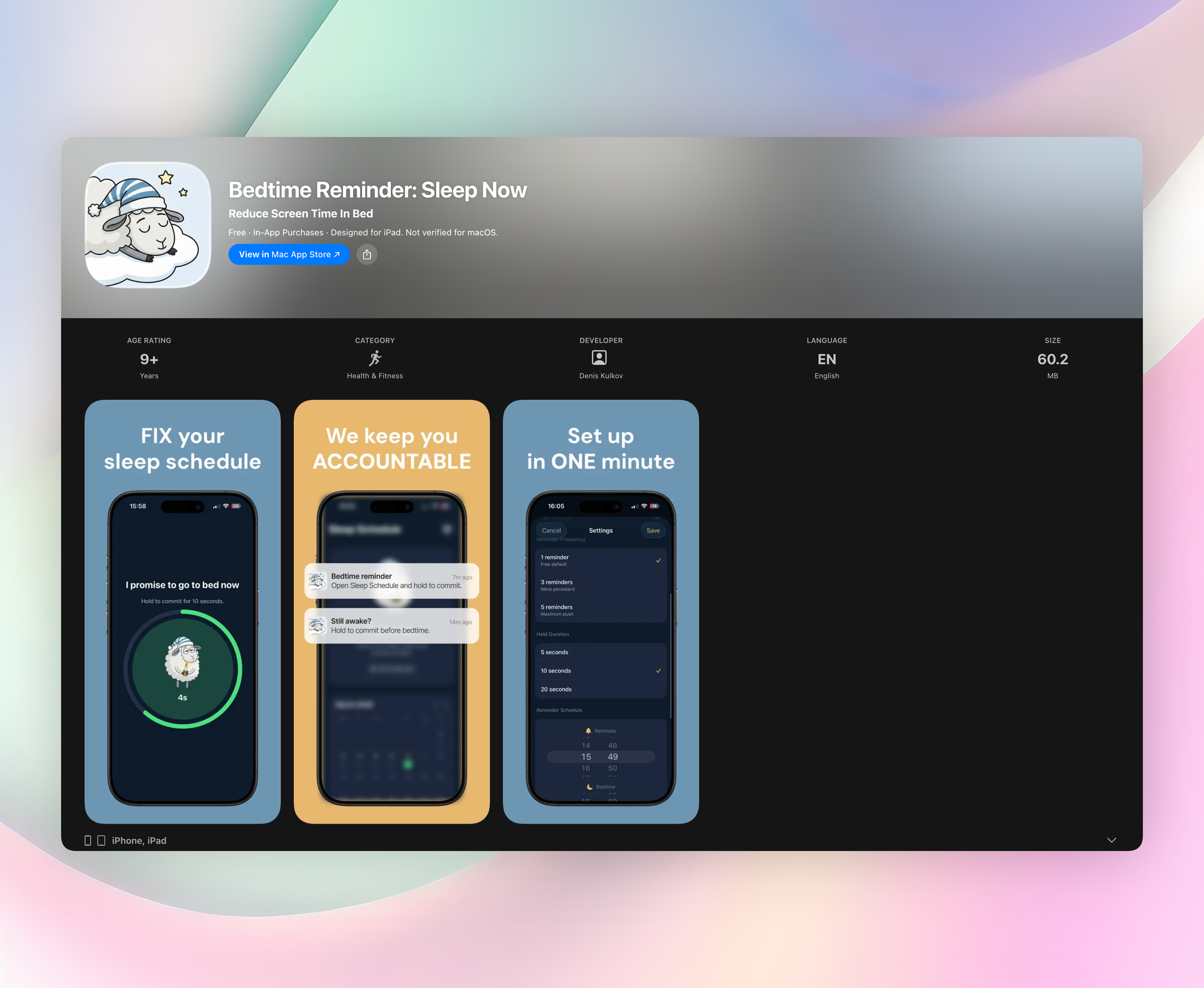
The practical failure is remembering. A wind-down that depends on noticing the clock rarely survives a busy evening, which is where Bedtime Reminder, a bedtime reminder app for iPhone, earns its place — the cue lands at the same hour every night, so whichever technique you're practicing gets a stable window to work in.
FAQ
How long should it take to fall asleep?
Roughly 10 to 20 minutes for most adults. Regularly needing more than 30 suggests the timing or the wind-down needs attention; regularly taking under 5 usually means sleep debt.
Can you really fall asleep in 10 seconds?
Not from a wired state. The ten seconds in the military routine refers to the final mind-clearing step, which follows about two minutes of muscle release and assumed weeks of practice. Sleep onset is a gradual handover, not a switch.
Which method works best for racing thoughts at night?
The shuffle. Breathing and muscle work address the body, so a mind replaying an argument keeps running underneath them. A stream of unrelated concrete images competes for the same workspace the rumination is using.
Does 4-7-8 work if I can't hold my breath for 7 counts?
Yes. Count faster and keep the 4:7:8 shape, or drop the hold and use in-for-4, out-for-6. The long exhale relative to the inhale is the active ingredient; the exact numbers aren't sacred.
What if none of them help?
If trouble falling asleep persists on most nights for months, that's worth raising with a doctor rather than cycling through more techniques. Structured programs for chronic insomnia exist, and clinicians generally reach for those first.
Free Bedtime Reminder tools
- Best Nap Length CalculatorPlan the best nap length for your available window. Get a suggested nap start, alarm time and a warning if the window is too short.
- Calories Burned Sleeping CalculatorEstimate calories burned during sleep, calories per hour and the share of a full day's resting burn. Add age, sex and height for a BMR comparison.
- Melatonin Timing PlannerWondering how much melatonin should I take? Choose a target bedtime and reason to see the clock window used in studies and their published dose range, presented as reference rather than advice.
- Night Shift Sleep Schedule PlannerPlan a repeatable sleep, nap and wake schedule around night shifts. The planner keeps your requested total sleep duration while showing the timing it used.
- REM Sleep CalculatorEstimate where REM-heavy late-night sleep may fit in your schedule. Enter time asleep, sleep onset and wake-up time for a range, not a precise measurement.
- Sleep Cycle CalculatorUse this sleep calculator to plan bedtimes or wake-up times around 4, 5 or 6 sleep cycles. Add the minutes you usually need to fall asleep.
- Sleep Debt CalculatorCompare your usual sleep need with actual sleep from recent nights. See total sleep debt or surplus, a nightly breakdown and an optional gradual recovery target.
- Sleep Efficiency CalculatorEnter time in bed and estimated time asleep to calculate sleep efficiency as a percentage and see the awake-time gap.
- Sleep Needs CalculatorFind how many hours of sleep you need by age, see the recommended nightly range, and work back to a bedtime from your wake-up time.
- Sleep TimerSet a sleep timer for 15 to 90 minutes or choose a custom duration. The low-glare countdown stays in your browser and can end with a gentle chime.
- White Noise GeneratorGenerate continuous white, pink or brown noise in your browser. Play it while you sleep, adjust the volume and optionally set a timer with a gentle fade-out.