
How long should a nap be — and when to take one
Nap length should match what you want from it. Ten to 20 minutes buys alertness with almost no grogginess, and about 90 minutes gets you a full sleep cycle. The stretch in between — roughly 30 to 60 minutes — is the one that backfires.
How long should a nap be, by purpose
| Nap length | What you get | How you wake up | Use it for |
|---|---|---|---|
| 5–10 min | A small alertness bump | Clean | When you can't spare more time |
| 10–20 min | Sharper attention, better mood and reaction time | Clean — you never leave light sleep | The default power nap length |
| 30–60 min | Deep sleep, cut off partway through | Groggy, often for 15 to 30 minutes | Nothing; this is the window to skip |
| 60–90 min | A full cycle: slow-wave sleep plus REM | Usually clean if the cycle finishes | Real sleep debt, night shifts, long-haul travel |
The short nap works because of where it leaves you. The first stretch of sleep is N1 and N2 — light stages you can exit easily. Twenty minutes is long enough to sharpen vigilance and lift mood, short enough that you never commit to the deep sleep that's hard to climb out of. That's the entire logic behind power nap length.
The 90-minute nap works for the opposite reason. A sleep cycle averages roughly 90 minutes, though anywhere from about 70 to 120 is normal, and it ends in light sleep or REM — stages that are easy to surface from. You get slow-wave sleep along the way, which is why a long nap does more for memory and physical recovery. It also takes a real bite out of that night's sleep drive.
Why a 30 minute nap feels worse than no nap
Sleep inertia is the fog you wake up in: heavy head, slow thinking, the sense that you've made things worse. It's strongest when you're pulled out of N3, the deep slow-wave stage, and it typically clears within 15 to 30 minutes — longer if you were already short on sleep.
Most people start sliding into slow-wave sleep somewhere around 20 to 25 minutes after they fall asleep, so an alarm at the 30-minute mark lands squarely in it. That's the whole problem: not that half an hour is too much rest, but that it interrupts the one stage you shouldn't interrupt. For how the stages sequence, see the stages of sleep.
That boundary moves. Sleep debt pulls deep sleep earlier, so even a 25-minute nap can land badly; being well rested pushes it later, and you might float in N2 past 30 minutes and wake fine.
One detail ruins more naps than any other: nap length means time asleep, not time lying down. If you take 10 minutes to drop off, a 30-minute alarm is a 20-minute nap. Set it for your usual fall-asleep time plus the sleep you actually want.
The best time to nap is the early-afternoon dip
Alertness doesn't decline in a straight line across the day. There's a dip in the early afternoon — roughly 1 to 3 p.m. for someone who gets up around 7. It's circadian rather than dietary: it shows up whether or not you ate lunch, driven by the same internal clock behind your body temperature curve and evening melatonin release (how the circadian rhythm works).
Nap inside that dip and two things go your way. You fall asleep faster, because your body is already primed for it, and you're far enough from bedtime that the nap doesn't cost you the night. Genuine night owls will find their dip an hour or two later — the window tracks your wake time, landing roughly six to eight hours after it.
Is napping good for you?
For anyone running short on sleep, yes. Napping benefits show up fastest in what sleep loss degrades first: sustained attention, reaction time, and mood. Short naps help well-rested people through the afternoon dip too, and longer naps that include slow-wave sleep and REM support memory consolidation and motor learning.
The caveat is that naps supplement night sleep rather than replace it. Two 90-minute naps aren't equivalent to three consolidated hours overnight, and no nap schedule makes a chronically short night harmless. Needing a nap daily despite a full night's opportunity is worth raising with a doctor, not solving with a better alarm.
The trade-off: a nap spends the sleep pressure you need at bedtime
Every hour you're awake builds sleep pressure, the homeostatic drive that makes sleep feel inevitable. Sleeping discharges it. A nap is a withdrawal from that account, and the size scales with how long and how deeply you slept.
That's the part most nap advice leaves out. Fifteen minutes at 1 p.m. barely registers by 11 p.m. Ninety minutes at 6 p.m. can leave you wide awake at midnight, short the next morning, and napping late again the next day. The working rule: keep naps inside the early-afternoon window, and don't nap within about eight hours of your target bedtime. Some people get away with six, and longer naps need a bigger buffer.
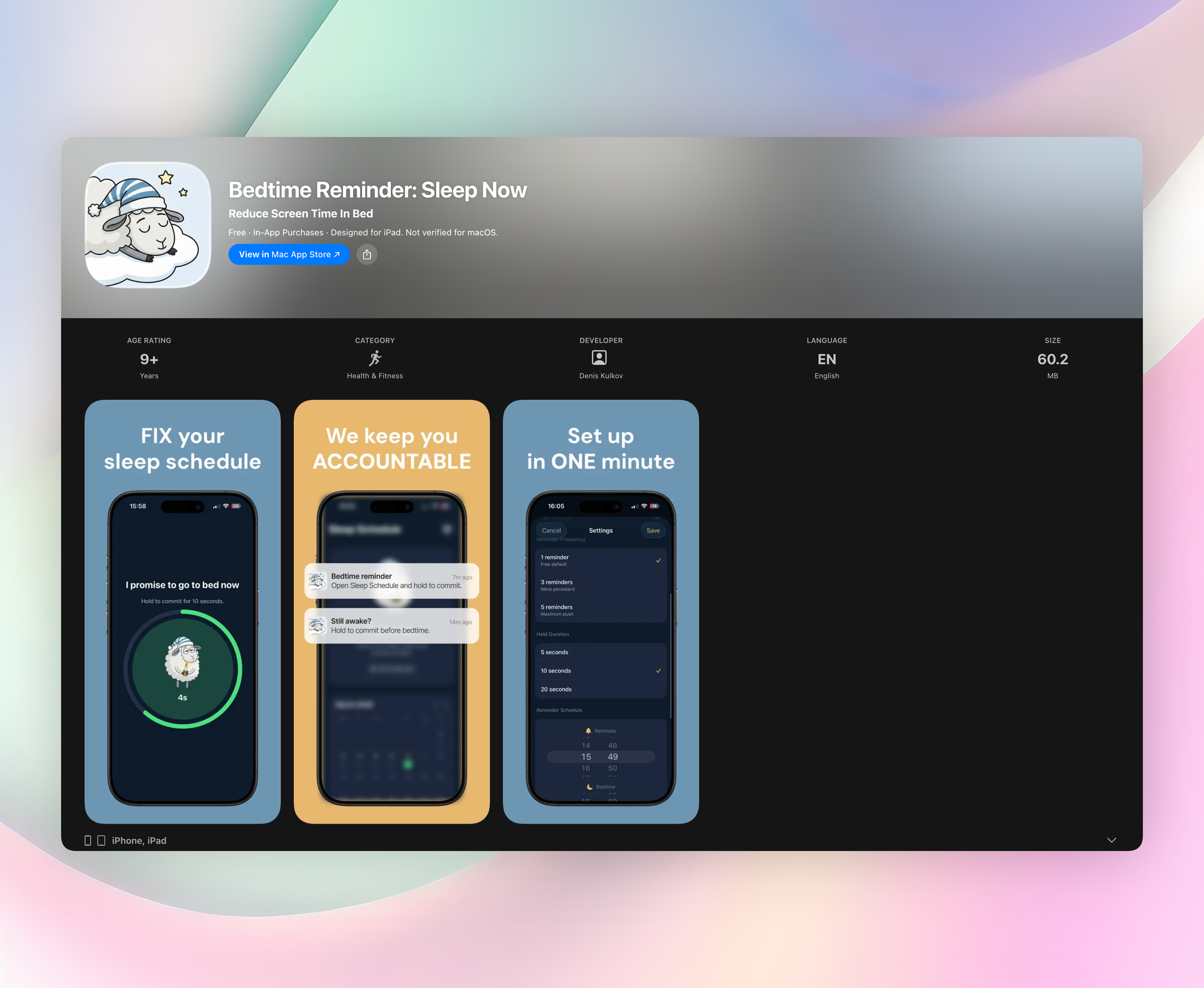
The rule only means something if that bedtime is a specific time you've committed to — not a vague "sometime around 11" — and if something tells you it's coming while there's still room to act. Bedtime Reminder is a bedtime reminder app for iPhone, which is enough to turn an abstract cutoff into a decision you can make at 3 p.m. If you've never picked a target at all, count backward from your wake time: what time should I go to bed.
How to nap without wrecking your night
- Nap in the dip, not after dinner. The clock matters more than the stopwatch.
- Set the alarm for fall-asleep time plus target sleep time, and put the phone out of reach.
- Keep the room dark and cool. Staying semi-upright on a couch keeps sleep shallow, which helps if you only want 15 minutes.
- Drink coffee immediately before a 20-minute nap when you need the strongest boost. Caffeine takes about 20 to 30 minutes to take hold, so it arrives roughly as you wake.
- Skip naps for a couple of weeks if you're trying to move bedtime earlier. Sleep pressure is the tool doing that work.
FAQ
How long is a nap supposed to be?
Ten to 20 minutes for alertness, or about 90 minutes when you want a complete cycle. Anything between roughly 30 and 60 minutes risks waking you out of deep sleep. Measure from when you fall asleep, not from when you lie down.
Is a 30 minute nap good or bad?
It's the riskiest of the common lengths. Around 20 to 25 minutes in, most people begin sliding into slow-wave sleep, so a 30-minute alarm often catches them there and produces grogginess. Well-rested sleepers sometimes stay light and wake fine, but 20 minutes is the safer bet.
Why am I more tired after a nap?
Sleep inertia. Waking out of deep sleep leaves you foggier than before you lay down, and it takes 15 to 30 minutes to wear off. Either shorten the nap so you stay in light sleep, or extend it to a full cycle.
What is the best time to nap?
The early-afternoon dip — roughly 1 to 3 p.m. for a typical wake time, or six to eight hours after you get up. Napping after about 4 p.m. eats into the sleep pressure you need that night.
Do naps count toward your daily sleep total?
Partly. Nap sleep is real sleep and does reduce sleep debt, but split sleep is generally less restorative than the same total in one block. Use naps to blunt a bad night, not to design a schedule around them.
Free Bedtime Reminder tools
- Best Nap Length CalculatorPlan the best nap length for your available window. Get a suggested nap start, alarm time and a warning if the window is too short.
- Calories Burned Sleeping CalculatorEstimate calories burned during sleep, calories per hour and the share of a full day's resting burn. Add age, sex and height for a BMR comparison.
- Melatonin Timing PlannerWondering how much melatonin should I take? Choose a target bedtime and reason to see the clock window used in studies and their published dose range, presented as reference rather than advice.
- Night Shift Sleep Schedule PlannerPlan a repeatable sleep, nap and wake schedule around night shifts. The planner keeps your requested total sleep duration while showing the timing it used.
- REM Sleep CalculatorEstimate where REM-heavy late-night sleep may fit in your schedule. Enter time asleep, sleep onset and wake-up time for a range, not a precise measurement.
- Sleep Cycle CalculatorUse this sleep calculator to plan bedtimes or wake-up times around 4, 5 or 6 sleep cycles. Add the minutes you usually need to fall asleep.
- Sleep Debt CalculatorCompare your usual sleep need with actual sleep from recent nights. See total sleep debt or surplus, a nightly breakdown and an optional gradual recovery target.
- Sleep Efficiency CalculatorEnter time in bed and estimated time asleep to calculate sleep efficiency as a percentage and see the awake-time gap.
- Sleep Needs CalculatorFind how many hours of sleep you need by age, see the recommended nightly range, and work back to a bedtime from your wake-up time.
- Sleep TimerSet a sleep timer for 15 to 90 minutes or choose a custom duration. The low-glare countdown stays in your browser and can end with a gentle chime.
- White Noise GeneratorGenerate continuous white, pink or brown noise in your browser. Play it while you sleep, adjust the volume and optionally set a timer with a gentle fade-out.