
Sleep inertia: the morning fog that isn't bad sleep
Sleep inertia is the grogginess that sits on you for the first 15 to 60 minutes after waking. It's normal physiology — your brain coming back online unevenly — not proof you slept badly. It's worst when an alarm pulls you out of deep sleep.
What is sleep inertia, in physiological terms
Waking isn't a switch. The brainstem arousal systems that make you conscious recover quickly, but the prefrontal cortex — planning, working memory, judgment — lags behind. Blood flow to those frontal regions climbs back toward daytime levels gradually, and adenosine, the sleep-pressure molecule that builds while you're awake and clears while you sleep, doesn't vanish the second your eyes open.
So for a while you're conscious but under-resourced — able to walk to the kitchen and answer a question, but not to trust your own read on how impaired you are, which inertia degrades first of all.
Inertia isn't the same as plain sleepiness. Sleepiness is pressure to fall asleep and can arrive at any hour; inertia only shows up on waking and fades on its own schedule regardless of what you do.
How long does sleep inertia last
After a normal night at a normal hour, the heaviest fog runs roughly 15 to 30 minutes, and most people feel functionally normal within an hour. It's a curve, not a cliff — impairment is steepest in the first few minutes and decays from there.
Three things stretch that curve:
- being pulled out of deep sleep rather than light sleep
- going in short on sleep
- waking at an unusual point in your body clock
Stack all three — an early alarm after a short night at the end of a drifting week — and the fog can last a couple of hours.
One practical consequence: decisions made at the alarm come from your least capable self — skipping the workout, canceling the plan, deciding the day is ruined. That's inertia talking, and it rarely survives contact with the you that exists forty minutes later.
Sleep inertia symptoms
The recognizable sleep inertia symptoms:
- slow, effortful thinking and leaky working memory
- sluggish reaction time, fumbled cups and dropped keys
- a beat of disorientation — not knowing the day, the hour, or the room
- flat or irritable mood
- heavy limbs and a strong pull back toward sleep
- poor insight into how impaired you actually are
They arrive together and fade together. What they don't do is last all day — grogginess still there at lunch usually means not enough sleep, or sleep that was broken up, rather than inertia.
When it's called sleep drunkenness
There's a more extreme version: confusional arousal, known informally by that name, means waking into real confusion — speech that doesn't track, disorientation past the usual window, sometimes no memory of the episode afterward. It's classed as a parasomnia rather than an ordinary rough morning, more likely after forced awakenings out of deep sleep or a run of short nights. Frequent occurrences are worth raising with a clinician rather than solving with a better alarm.
Why am I tired after 8 hours of sleep
Because duration is one of three variables, and it's the only one most people track.
Timing variability. Sleep runs in cycles of roughly 90 minutes, with the deep, slow-wave portion front-loaded into the first half of the night, so where the alarm lands matters as much as how long you were in bed. A bedtime that swings by 90 minutes across the week puts the alarm at a different point in a different cycle each morning, and some mornings it cuts straight through deep sleep: enough total sleep, terrible exit point. That's the classic "why am I tired after eight hours" morning — the stages your sleep moves through explain most of the gap.
Fragmentation. Eight hours in bed isn't eight hours asleep. Alcohol, a warm room, a late coffee, a partner, or a pet all fragment sleep in ways you don't remember, and fragmented sleep restores less than its length suggests.
Accumulated debt. Four short nights don't clear with one long one — you wake with sleep pressure still on board, which makes inertia deeper and longer.
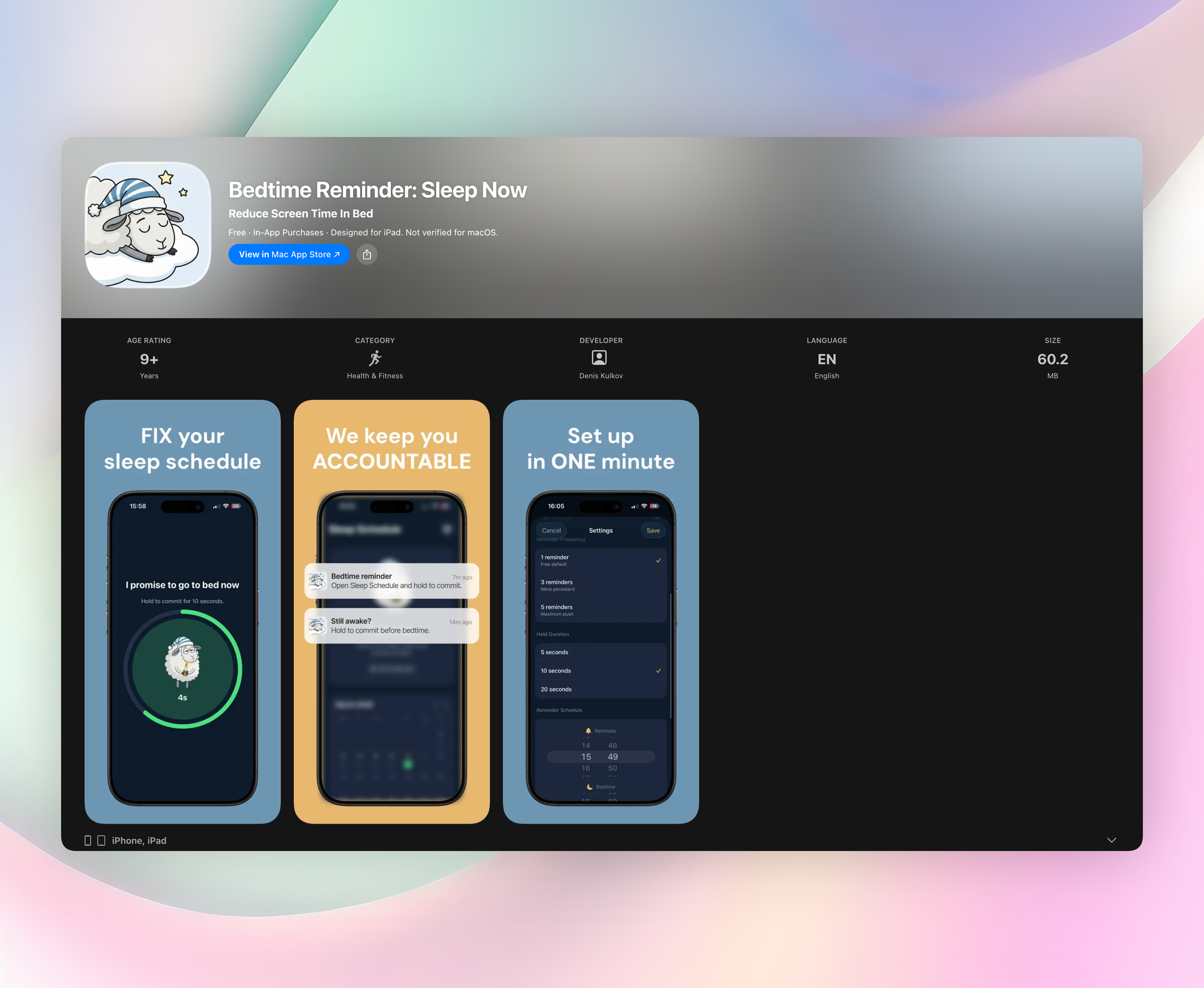
The variable actually under your control is timing. A consistent sleep schedule keeps the alarm from landing at a different point in the cycle each day, and the anchor is bedtime, not wake time, which is usually fixed for you already. Bedtime Reminder, a bedtime reminder app for iPhone, is one way to keep that hour from drifting — the difference between an alarm that mostly lands in light sleep and one that repeatedly lands mid-cycle.
What actually shortens sleep inertia
Nothing abolishes it. A few things measurably compress it, and a few popular things do less than advertised.
| What you do | Why it helps | How fast | How solid the evidence |
|---|---|---|---|
| Get outside into daylight | Far brighter than indoor light — roughly 100–300 lux inside vs. 1,000+ outside, even under cloud | 5–10 minutes | Strong |
| Move — walk, stairs, anything light | Raises heart rate and core temperature, both still at night-time levels | Within minutes | Good |
| Cold water on the face or a cool shower | Sharp sensory input plus a temperature nudge | Immediate but short-lived | Modest |
| Caffeine | Blocks adenosine at the receptor; felt in roughly 20–45 minutes | Not instant | Strong for alertness, silent on timing |
| One alarm at the real wake time | Removes the repeated fall-back-asleep-and-be-woken-again cycle | Same morning | Mixed, but low cost |
| A steady bedtime | Keeps the alarm landing at a consistent point in the cycle | Over a week or two | Strongest long-term lever |
A few of those deserve honesty about their limits.
Snoozing. The intuitive case against it: each snooze lets you slide back toward sleep, then yanks you out again. The evidence is less one-sided than that suggests — a short snooze spent in light sleep doesn't wreck anyone's morning. The durable rule isn't "never snooze," it's "set the alarm for when you actually intend to get up."
Delaying your first coffee. The popular advice is to wait 60–90 minutes after waking so caffeine doesn't blunt your morning cortisol rise — plausible, but thinly evidenced, so treat it as an experiment rather than a rule. Better established: caffeine's half-life runs around five hours, so an afternoon cup is still working at bedtime, fragmenting the night that produces tomorrow's inertia.
Naps. Inertia isn't only a morning phenomenon. Nap past about 25–30 minutes and you risk dropping into slow-wave sleep, waking with a fresh dose of fog. Keeping naps to 10–20 minutes usually avoids it — nap length is the single setting that decides whether a nap helps or costs you an hour.
FAQ
How long does sleep inertia last?
Usually 15 to 60 minutes, worst in the first 15 to 30. It runs longer after a short night, an early alarm, or an awakening out of deep sleep. Fog that's still there hours later is more likely insufficient or broken sleep than inertia.
Why do I wake up tired even after a full night?
Most often because the alarm cut into a deep-sleep stage, not because you slept too little. Irregular bedtimes make that mistimed exit more likely, since the alarm lands at a different point in the cycle each day. Fragmented sleep or leftover debt from earlier in the week can produce the same feeling.
Is sleep drunkenness the same as sleep inertia?
Same spectrum, not the same thing. Ordinary grogginess is expected physiology; confusional arousal involves genuine disorientation, incoherent speech, and sometimes amnesia for the episode, and is treated as a parasomnia. Frequent episodes are worth discussing with a clinician.
Does hitting snooze make sleep inertia worse?
Probably less than commonly claimed — it depends on whether those extra minutes are light sleep or drifting deeper. The bigger cost is that snoozing hands your wake-up decision to your foggiest self. Setting one alarm at the time you actually plan to rise sidesteps the issue.
Can you wake up without sleep inertia?
Not reliably — some fog on waking is normal. Keep it short and mild with a consistent bedtime, enough total sleep, and light plus movement in the first ten minutes. A wake time that stays the same across the week does more than any single morning trick.
Free Bedtime Reminder tools
- Best Nap Length CalculatorPlan the best nap length for your available window. Get a suggested nap start, alarm time and a warning if the window is too short.
- Calories Burned Sleeping CalculatorEstimate calories burned during sleep, calories per hour and the share of a full day's resting burn. Add age, sex and height for a BMR comparison.
- Melatonin Timing PlannerWondering how much melatonin should I take? Choose a target bedtime and reason to see the clock window used in studies and their published dose range, presented as reference rather than advice.
- Night Shift Sleep Schedule PlannerPlan a repeatable sleep, nap and wake schedule around night shifts. The planner keeps your requested total sleep duration while showing the timing it used.
- REM Sleep CalculatorEstimate where REM-heavy late-night sleep may fit in your schedule. Enter time asleep, sleep onset and wake-up time for a range, not a precise measurement.
- Sleep Cycle CalculatorUse this sleep calculator to plan bedtimes or wake-up times around 4, 5 or 6 sleep cycles. Add the minutes you usually need to fall asleep.
- Sleep Debt CalculatorCompare your usual sleep need with actual sleep from recent nights. See total sleep debt or surplus, a nightly breakdown and an optional gradual recovery target.
- Sleep Efficiency CalculatorEnter time in bed and estimated time asleep to calculate sleep efficiency as a percentage and see the awake-time gap.
- Sleep Needs CalculatorFind how many hours of sleep you need by age, see the recommended nightly range, and work back to a bedtime from your wake-up time.
- Sleep TimerSet a sleep timer for 15 to 90 minutes or choose a custom duration. The low-glare countdown stays in your browser and can end with a gentle chime.
- White Noise GeneratorGenerate continuous white, pink or brown noise in your browser. Play it while you sleep, adjust the volume and optionally set a timer with a gentle fade-out.