
How long can you go without sleep: the hour-by-hour timeline
Most people can stay awake 24 to 48 hours before thinking, mood, and coordination fall apart in obvious ways. The longest carefully documented stretch is 264 hours — 11 days. Real impairment shows up far earlier, usually before you feel wrecked.
How long can you go without sleep before it gets dangerous
There's no clean cutoff, because sleep loss is a slope, not a cliff. Performance starts sliding around 16 to 18 hours awake — the end of an ordinary long day. Every hour past that costs more than the one before it, and the deficit compounds if you arrived already short.
The comparison that lands hardest involves alcohol. Roughly 17 to 19 hours of continuous wakefulness degrades reaction time and tracking accuracy about as much as a blood alcohol concentration of 0.05%. A full day awake puts the equivalent near 0.10% — over the legal driving limit in every US state. You don't feel drunk. You feel tired, and tiredness doesn't arrive with the same internal warning label.
The sleep deprivation timeline below is typical, not fixed. Age, chronotype, prior sleep debt, and caffeine all shift it.
| Time awake | What usually shows up |
|---|---|
| 16–18 hours | Slower reactions, sloppier decisions, irritability |
| 24 hours | Attention lapses, weak working memory, poor judgment |
| 36 hours | Involuntary sleep lapses; emotional volatility; hormonal shifts |
| 48 hours | Lapses become frequent and unstoppable; perceptual distortion |
| 72 hours+ | Visual hallucinations, paranoia, disorganized thinking |
24 hours without sleep
One night through. Attention goes patchy rather than uniformly bad — you hold a conversation fine, then miss something obvious thirty seconds later. Working memory drops, risk assessment worsens, mood swings widen. Caffeine and adrenaline mask the sleepiness without restoring the performance, which is why this is the stage where people rate themselves as fine and then drift out of a lane.
36 hours awake
Sleep pressure starts overriding intent. Emotional regulation weakens: small annoyances land harder, and reading other people's faces gets less accurate. Appetite hormones shift, inflammatory markers rise, temperature regulation turns unreliable. Speech slows and word-finding stumbles.
48 hours without sleep
Two days in, the brain forces brief involuntary shutdowns whether or not you consent. Perception gets unreliable at the edges — patterns in carpet or wallpaper seem to move, peripheral shapes register as motion, time estimation goes badly wrong. Many people describe a flat, detached feeling, like watching themselves from slightly outside.
72 hours without sleep and beyond
Past three days the picture shifts from impaired to something closer to a temporary psychiatric state. Simple visual hallucinations become common and can progress to complex ones — figures, animals, people who aren't there. Reasoning gets disorganized and paranoid ideas take hold. Studies of extended wakefulness describe a consistent progression: perceptual distortion, then illusions, then hallucinations, then delusional belief.
Microsleeps start long before you feel dangerous
A microsleep is a brief intrusion of sleep into wakefulness, typically lasting from a fraction of a second up to about 15 seconds. On an EEG it looks like sleep. From the inside it looks like nothing — eyes can stay open, posture holds, and the person usually insists they never nodded off.
That invisibility is the hazard. These lapses don't wait for the dramatic end of the timeline; under enough sleep pressure they appear after a single short night. At highway speed, four blank seconds covers more than a hundred yards of road with nobody driving. Monotonous tasks, warm rooms, and the early-afternoon circadian dip all make them likelier.
The world record for no sleep, and why it isn't tracked
The best-known case is Randy Gardner, a San Diego high school student who stayed awake 264 hours — about 11 days — over the 1963–64 winter break for a science fair, observed by sleep researchers. He had memory lapses, trouble concentrating, paranoia, and hallucinations, then recovered after a long sleep. Longer figures have been claimed since, with thinner monitoring.
Guinness World Records retired the category on safety grounds: a record that rewards deliberate self-harm invites imitation, and there's no safe way to attempt it. The world record for no sleep is a historical footnote now, not a live leaderboard.
Chronic short sleep does more damage than the all-nighter
In controlled restriction experiments, people held to about six hours a night for two weeks performed on attention tests roughly as badly as people kept awake for a full day. The striking part was their self-assessment: they rated themselves only slightly sleepy. The deficit accumulated. The awareness of it didn't.
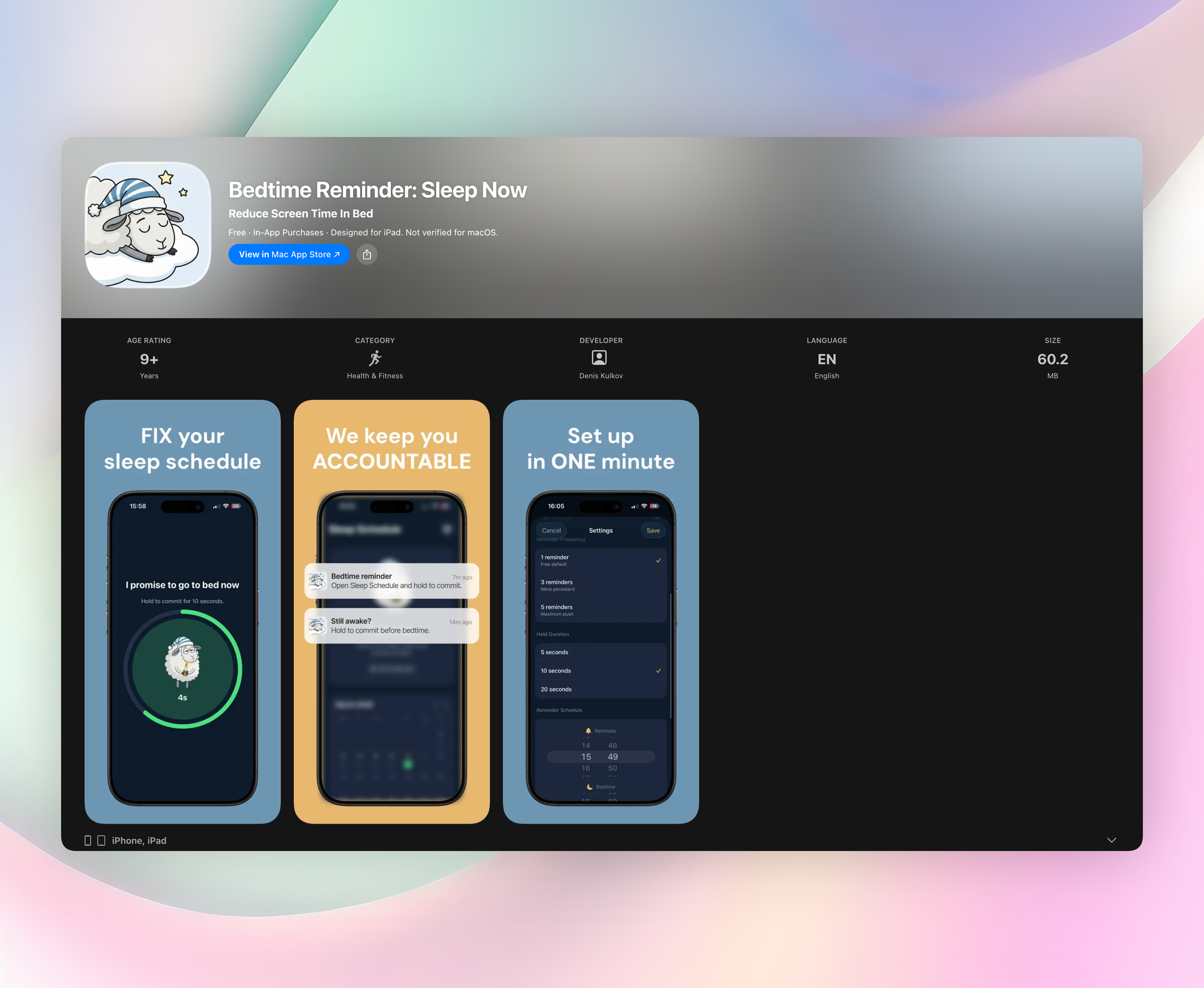
That asymmetry is the point. An all-nighter is loud — you feel every hour and you go to bed early the next night. Five-hour nights, repeated, are silent, and they build a larger cumulative deficit with none of the warning signals. Chronic short sleep is usually a scheduling failure rather than a biology one, which makes it the more tractable kind. Most undersleeping people already know what time they should be in bed and simply get no nudge at that hour. Bedtime Reminder is a bedtime reminder app for iPhone, which puts that decision at 10 p.m. instead of at midnight.
If the backlog has already built up, sleep debt recovery covers what a weekend can and can't undo; if bedtime keeps sliding later, fixing your sleep schedule is the more durable repair.
What recovery actually takes
One long sleep after a night up restores a surprising amount. Deep sleep rebounds first — the body prioritizes it — with REM catching up across the following nights. Subjective alertness returns faster than measured performance, which is why people feel recovered before their reaction times do.
After several days of restriction, one long weekend helps but doesn't clear the ledger. Attention measures can still trail baseline after a couple of recovery nights, and returning to a healthy sleep schedule does more than sleeping until 1 p.m. on Sunday.
FAQ
Can you die from not sleeping?
Not from ordinary sleep loss — no confirmed human death has been attributed to voluntary wakefulness alone. Total sleep deprivation is fatal in rodents in laboratory studies, and fatal familial insomnia, a rare prion disease, destroys the capacity for sleep and is fatal. Neither resembles staying up for a few nights.
How long can you go without sleep before you hallucinate?
Perceptual distortions can begin around 24 to 48 hours awake, and simple visual hallucinations commonly appear between 48 and 72 hours. Complex hallucinations usually take three days or more. Existing sleep debt moves the whole schedule earlier.
Is one all-nighter bad for you?
One night without sleep is unpleasant and genuinely dangerous behind the wheel, but a healthy adult generally recovers within a night or two. Repeated short nights are the larger concern, because the deficit keeps growing while the feeling of sleepiness plateaus.
What is the longest anyone has stayed awake?
264 hours — 11 days — by Randy Gardner in 1963–64, the most closely observed case on record. Longer claims exist from later attempts, but sleep deprivation records are no longer certified by Guinness.
Does caffeine cancel sleep loss?
No. Caffeine blocks adenosine signaling, which dulls the feeling of sleepiness, while the underlying performance deficit persists and adenosine keeps accumulating. That combination is the dangerous one: someone who feels alert and still tests impaired.
Free Bedtime Reminder tools
- Best Nap Length CalculatorPlan the best nap length for your available window. Get a suggested nap start, alarm time and a warning if the window is too short.
- Calories Burned Sleeping CalculatorEstimate calories burned during sleep, calories per hour and the share of a full day's resting burn. Add age, sex and height for a BMR comparison.
- Melatonin Timing PlannerWondering how much melatonin should I take? Choose a target bedtime and reason to see the clock window used in studies and their published dose range, presented as reference rather than advice.
- Night Shift Sleep Schedule PlannerPlan a repeatable sleep, nap and wake schedule around night shifts. The planner keeps your requested total sleep duration while showing the timing it used.
- REM Sleep CalculatorEstimate where REM-heavy late-night sleep may fit in your schedule. Enter time asleep, sleep onset and wake-up time for a range, not a precise measurement.
- Sleep Cycle CalculatorUse this sleep calculator to plan bedtimes or wake-up times around 4, 5 or 6 sleep cycles. Add the minutes you usually need to fall asleep.
- Sleep Debt CalculatorCompare your usual sleep need with actual sleep from recent nights. See total sleep debt or surplus, a nightly breakdown and an optional gradual recovery target.
- Sleep Efficiency CalculatorEnter time in bed and estimated time asleep to calculate sleep efficiency as a percentage and see the awake-time gap.
- Sleep Needs CalculatorFind how many hours of sleep you need by age, see the recommended nightly range, and work back to a bedtime from your wake-up time.
- Sleep TimerSet a sleep timer for 15 to 90 minutes or choose a custom duration. The low-glare countdown stays in your browser and can end with a gentle chime.
- White Noise GeneratorGenerate continuous white, pink or brown noise in your browser. Play it while you sleep, adjust the volume and optionally set a timer with a gentle fade-out.